
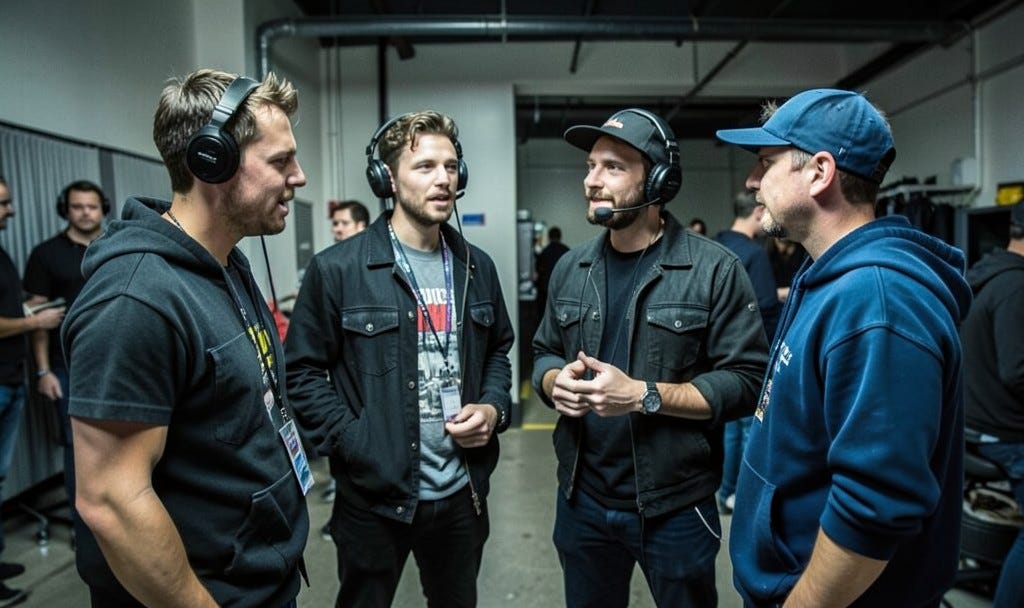
My wife works events around San Francisco — conferences, mostly, which almost always means some flavor of tech event. I've gone with her a few times so I can scope out the crowd beforehand and give her a heads-up on what she's walking into and who she'll be dealing with.
Today I dropped her off at the Pokemon event at Chase Center — a huge deal for that community. I told her she was about to meet some of the most delightful, sincere people she'd run into in a long time. Earlier in the week she'd worked an investment conference. I'll leave the details there.
That same week, I overheard someone telling a friend about a dinner that was supposed to be about connecting with like-minded people — really getting to know each other, connecting on some spiritual level. Instead, it turned into a room full of tech entrepreneurs talking about nothing but money: how much they'd raised, at what valuation, what percentage of the company they'd had to give up. Those are all things that matter enormously if you're the one raising the round — proof you cut a good deal, that you didn't give away too much of your company to get funded. Fair enough, in context. But as an evening with people you're supposed to be getting to know? It's a dick-measuring contest with a cover charge, and I felt for whoever's dinner got ruined by it.
Driving my wife to the Pokemon event afterward, thinking out loud the way I do — she tolerates this, she's locked in, focused on the work ahead, and I ramble — I found myself explaining to her what the term "tech bro" actually means, and where it came from.
These days, especially since Trump's most recent inauguration, when a row of tech industry leaders stood on stage behind him, "tech bro" has come to mean something like: one of the captains of the technology industry now using that technology in ways that no longer benefit the public, and maybe don't benefit anyone but themselves.
But the term is older than that. It goes back to around 2010, when companies like Uber were getting funded at billion-dollar private valuations — "unicorns," we called them. In the AI era, a billion-dollar private valuation is quaint. There are private companies now valued in the hundreds of billions. How much my own business has changed over the past 40 years is a topic for another day.
The archetype "tech bro" describes is a specific kind of person: did well in school, genuinely smart, went to a good university, but also more outgoing and gregarious than earlier generations of engineers — exactly the kind of person who, a generation earlier, would have gone to work at a finance firm on Wall Street. Picture scenes from The Wolf of Wall Street. That energy showed up in Silicon Valley, and the driving force became money. Not even 10x-ing a business was enough anymore — it had to be 100x, with a big exit for everyone who got in early.
Here's what I think is hard for my wife, and probably for a lot of people outside the industry, to understand: the tech bros didn't just show up and do financial engineering. Early-stage entrepreneurs, historically, wrote the code themselves and built the product themselves, and to their credit, the tech bros learned to code and applied it. Nothing wrong with that.
What I don't think everyone realizes is that none of it would have been possible without one thing that happened just before their era: open source. When I started in this business, you and your colleagues wrote every line of code from scratch. C and C++ had some standard libraries, and you could license the odd third-party tool, but building your first product meant staring at a blank screen. There wasn't a single line of code out there for you to start from.
I've been on both sides of that divide — I built software the hard way, and now, like everyone else, I'm a huge consumer of open source. I'm fairly certain that if the tech bros had shown up in Silicon Valley a little earlier, during my era, they would not have been able to build what they built. Open source was the first truly dramatic change in how software got made at early-stage companies, and it's still happening. Start with Linux, an operating system built from scratch by Linus Torvalds and given away for free, which irrevocably altered the landscape of the internet. Within a few years, Sun Microsystems, which the internet had literally run on, Solaris, SPARC, was gone, replaced by free software. Linux now runs the entire internet. Layer on every other open source project on the front end and back end, Ruby, JavaScript, PHP, you name it, plus the walkthroughs, tutorials, and places like Stack Overflow where someone would just answer your question. Software development in 2010 was dramatically easier than it had been in the 1990s, never mind the 1980s.
So the tech bros are standing on the shoulders of a lot of very talented, very dedicated engineers with a libertarian streak who believed software should be free, and still believe it today.
Which brings me back to the Pokemon community, and what makes it charming: it's not just kids, there are plenty of grown-ups too, and by and large they are wonderful, sincere people. I can't help but wonder if that community has more in common with the engineers who built open source software than with the tech bros — the same openness, the same sincerity. I know which conference I would rather go to. I played Pokémon with my son when he was younger.
The tech bros ruined the industry I loved by making it all about money. And the latest crop of them seems to be working on ruining the country, turning it into something it was never supposed to be. Instead of a democracy, a technocracy, where software and AI direct the government and therefore direct what people are and aren't allowed to do. I just hope people understand how we got here, and where it came from.