
There’s a deceptively healthy-looking organizational pattern that quietly breaks down in mid-sized engineering teams. It looks like this: a handful of product managers, each running a small pod of engineers, everyone moving fast, shipping product. From the outside, things are humming.
The cracks appear later. Some part of the database is straining under load you could have predicted. A shared library has three incompatible versions living in three different pods. Nobody owns the work needed to fix it, because nobody was ever asked to.
The problem isn’t the pod structure — that part works. The problem is a missing team.
How the pod model is set up
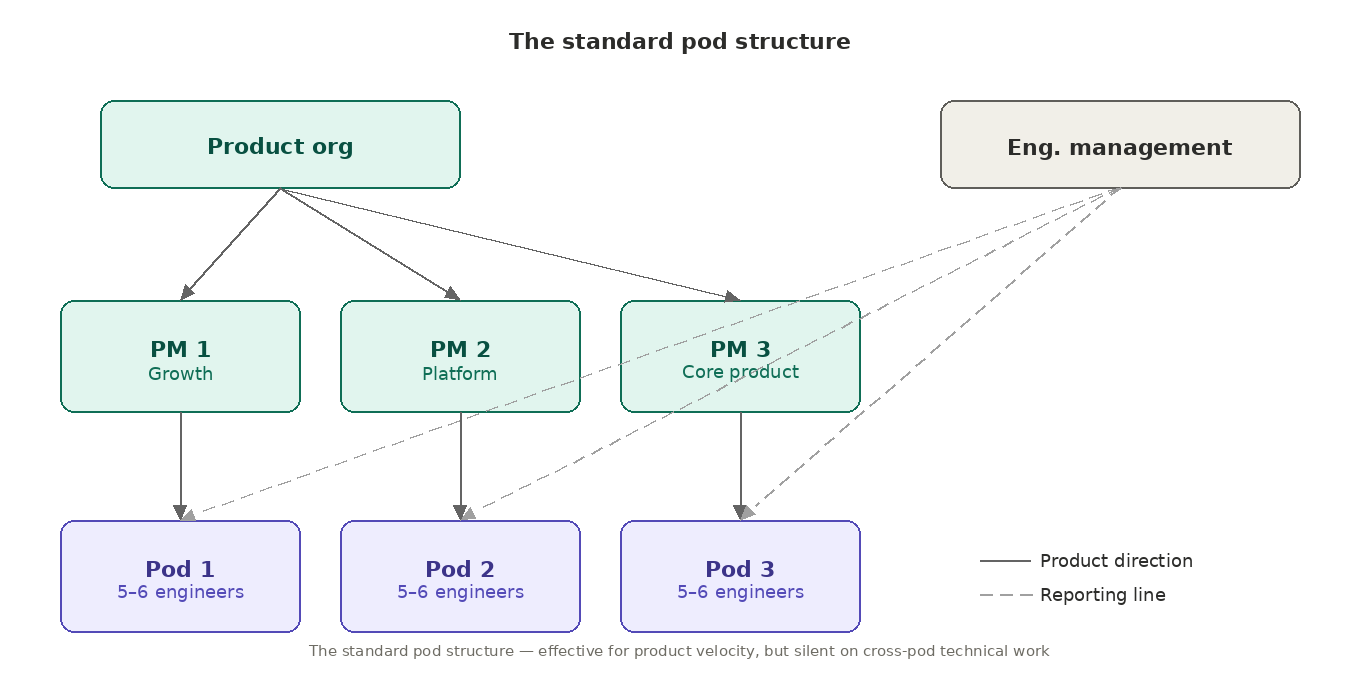
The typical structure is elegant in its simplicity. You have five or six product managers, each paired with a pod of engineers — say, five or six people, led by a tech lead. A layer of engineering management sits across those pods. Engineers report up through management but work day-to-day with their product manager.
This creates something genuinely valuable: tight product-engineering alignment at the team level. Engineers understand the “why” behind what they’re building. Product managers develop technical intuition. The pod is largely autonomous, with few dependencies on other teams.
Product orgEng. managementPM 1GrowthPM 2PlatformPM 3Core productPod 15–6 engineersPod 25–6 engineersPod 35–6 engineersSolid = product directionDashed = reporting line
The standard pod structure — effective for product velocity, but silent on cross-pod technical work
At 40–50 engineers across six pods, this is a formidable product machine. But notice what’s missing from the diagram above: there’s no regular forum where the engineers in those pods talk to each other as a technical community.
The asymmetry nobody talks about
Here’s a tension baked into the pod model. The product organization is small — six people who meet regularly, coordinate roadmaps, and share context. They function as a team. The engineering organization is five or six times larger, and typically meets in fragments: each pod runs its own standups and planning, but the 40-person engineering org rarely convenes as a whole.
This isn’t a failure of management. A weekly all-hands with 40 engineers is genuinely unwieldy. But the practical consequence is that nobody is holding the cross-cutting technical picture.
Where it breaks down: Shared architectural components that two pods both touch. Technical debt that doesn’t belong to any PM’s roadmap. Infrastructure that needs re-architecture to support the growth the product team has already planned for — but hasn’t told engineering about yet.
The product team has visibility into what’s coming. The pod teams have deep visibility into their own corner. No one has the full technical view. That’s the gap.
The tech lead council
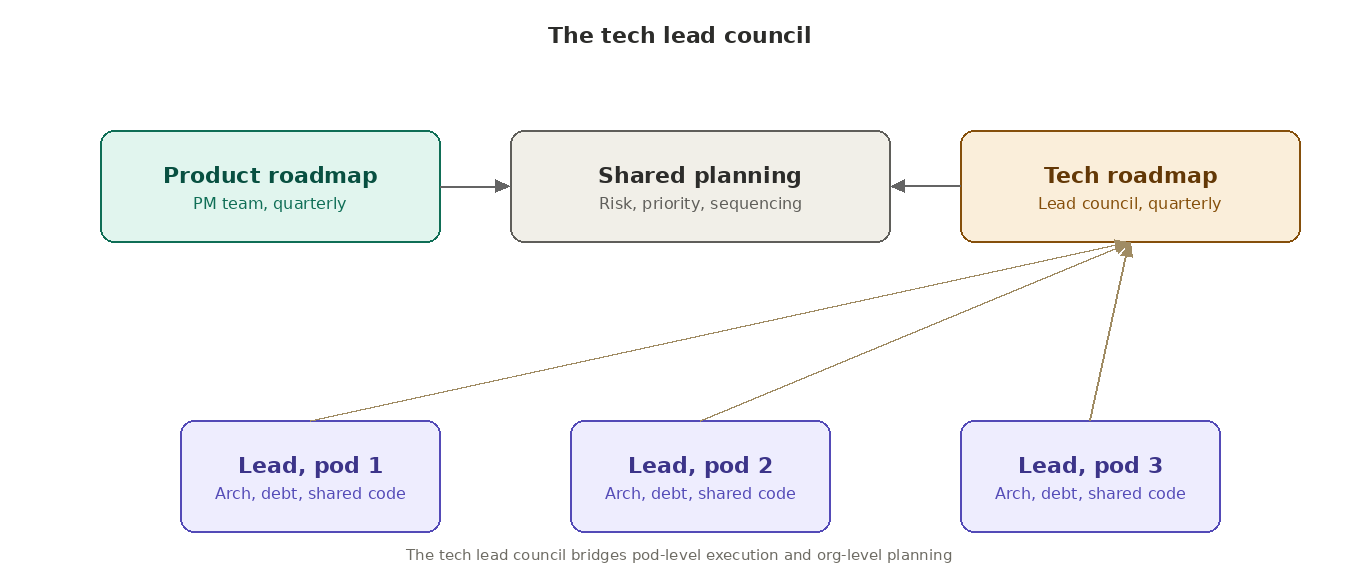
The fix is a standing team of tech leads — one from each pod — meeting on the same cadence as the rest of the organization. Call it a tech lead council, an architecture forum, whatever fits your culture. The name matters less than the habit.
This team does something specific: it holds the technical picture that no individual pod can hold on its own.
In practice that means: comparing implementation approaches across pods before work diverges, identifying opportunities for shared components, surfacing technical work that needs to happen for business reasons no PM has yet named, and developing a 6–12 month technical roadmap that runs alongside the product roadmap.
Product roadmapPM team, quarterlyTech roadmapLead council, quarterlyShared planningRisk, priority, sequencingLead, pod 1Arch, debt, shared codeLead, pod 2Arch, debt, shared codeLead, pod 3Arch, debt, shared code
The tech lead council bridges pod-level execution and org-level planning
The goal is that this team’s outputs — architectural recommendations, decisions to adopt new tooling, proposals to allocate sprint capacity to debt retirement — are treated with the same weight as product requirements. That takes time to earn. The team earns it by being right consistently, by communicating their reasoning clearly, and by building a track record the rest of the organization learns to trust.
“At the same time you’re developing a vision of what the product will look like a year from now, you need a group of people meeting regularly to discuss what the future of your technical stack looks like.”
In more mature organizations, this function often migrates toward staff engineers or a principal engineering group. The exact structure depends on where the company is. What shouldn’t vary is the underlying principle: technical planning must be ongoing, structured, and given organizational standing.
Team-ness at every level
There’s a broader pattern here, one that applies not just to tech leads but to every layer of the organization. The most effective teams aren’t collections of individuals each reporting to a shared manager. They’re actual teams — people with shared goals who work together on the business of their level, not just up and down their individual reporting lines.
One CEO put it well to his executive team: “You’re not six people who each report to me. You’re a team, and I’m the lead of that team.” The consequence was that most decisions got made and executed by the team, without the CEO needing to be in the room. Issues came to the weekly meeting; only the things that required a tiebreaker or an especially consequential call escalated further.
The same logic applies at the tech lead level. If those leads see themselves as a team — not just representatives of their respective pods attending a meeting — they’ll make better architectural decisions, resolve cross-pod tensions more quickly, and present a more coherent technical direction to the rest of the organization.
Putting it into practice
None of this requires a reorg. It requires one standing meeting, a clear mandate, and leadership willing to treat the outputs as real inputs to planning. Start with the tech leads meeting biweekly. Give them a simple agenda: what architectural work is each pod planning this sprint, is any of it shared, and what technical work needs to happen in the next six months that isn’t on any PM’s roadmap yet.
The meeting will feel unfocused at first. Give it three months. By then, the leads will have developed shared context, a working vocabulary, and a sense of what they can resolve themselves versus what needs to escalate. That’s when the value shows up — not in a single decision, but in a dozen small ones that don’t require a VP to broker.
The pod model gives you product velocity. The tech lead council gives you the architectural coherence to sustain it. You need both.