
I've spent 40 years in technology now, and I've come into contact with a lot of people in that time — which means I've had a lot of chances to learn what separates the people who thrive in business and in life from the people who don't. I think about this more than usual these days, because my son just turned 18 and graduated high school, and he's trying to figure out what he wants to do with his life. I want him to learn some of this earlier than I did.
There's a long list of skills we could talk about, but one in particular has been on my mind: the ability to read other people.
I came to this the slow way, through watching salespeople. For a long time I genuinely didn't understand what made someone good at that job, or even what the job actually was. It's easy to say “they sell stuff,” but that's nowhere close to the real answer. The actual job of sales is to build relationships with clients, and through those relationships, understand what they need — and then figure out what you and your company can actually do to help them meet their own goals. That's the whole craft. Everything else follows from it.
Part of what makes that possible is a skill most people never have to develop in ordinary life: meeting someone and, fairly quickly, figuring out whether they're in a position to help you accomplish something. Good salespeople walk into a company and want to know, as fast as possible, who the actual decision-makers are. Beyond just understanding what the customer needs, the real question is always: how does this sale actually get made? That often means climbing a ladder, or reading an org chart, to figure out who plays what role in getting a decision over the line.
I was an introvert — genuinely, extremely shy — for most of my early life, and it took me years to even recognize that this kind of reading-people work was a real, learnable skill, let alone one I needed. There's a cynical way to frame it: are you just sizing people up to figure out how to use them? A good salesperson never lets the other person feel that way, even though, underneath it, there's a real evaluation happening.
I got to see this from the other side, too, and for a long time I mostly missed the lesson. I was fortunate enough to learn to program in the late '80s, and then to build my professional career through the 90s, 2000s, and 2010s — about as good a stretch as there's ever been to be a software engineer. I focused almost entirely on the engineering and the coding. I met a huge range of people along the way, but it never occurred to me to think about whether any given person might be someone who could help me get where I was going. I prided myself on being self-sufficient — or at least I thought I was — and figuring everything out on my own. It took me a long time to realize that's not the only way to move through the world, and honestly not even a particularly good one. There are a lot of ways to solve problems, and a lot of them don't require learning everything yourself. Sometimes the whole move is just finding someone who knows more than you do and getting them talking — which, it turns out, usually isn't that hard.
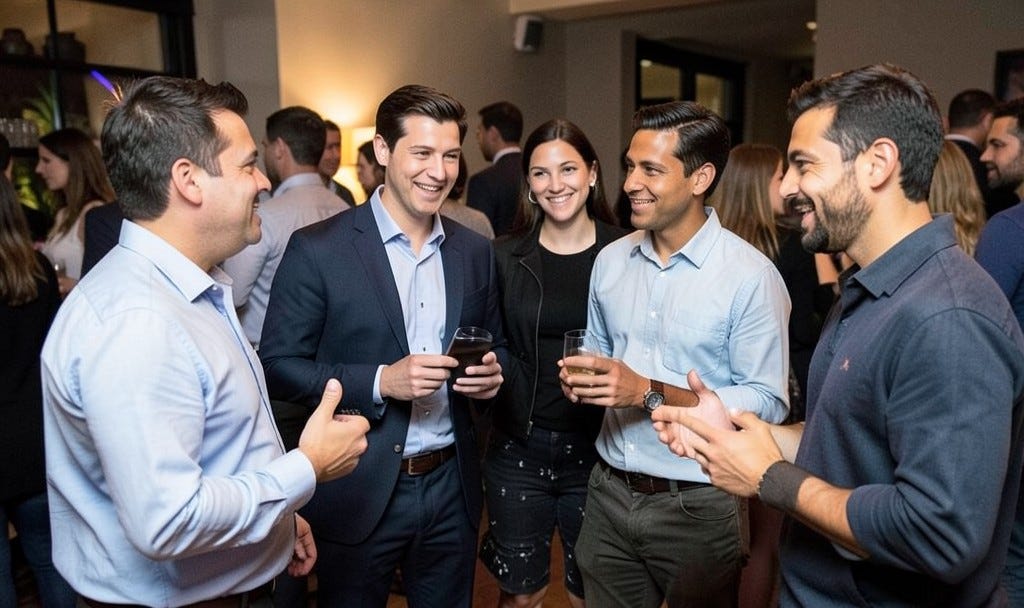
This is what I want for my son: real social skills, real effectiveness at networking, and an early understanding that in almost any relationship, there's a give and take. What two people can offer each other isn't always obvious up front. But if you actually get to know somebody, it usually turns out there are things you can help each other with — and that, once it goes both ways, is just called friendship. I'll admit I haven't always been a great friend to the people I've met over the course of my career — that's a topic for its own piece — but the underlying lesson still stands.
The best salespeople I've watched do something harder than closing deals: they put people at ease, and they make them feel genuinely good about what they're building together, without ever making them feel used. That's a real skill, not a trick, and it applies well beyond sales. Even if your job is just writing code — which was my job, for a very long time — there is enormous opportunity in learning from the people around you and helping them in return. I wish I'd learned that decades before I did. It's at the top of the list of things I want to teach my son, as early as I possibly can.