
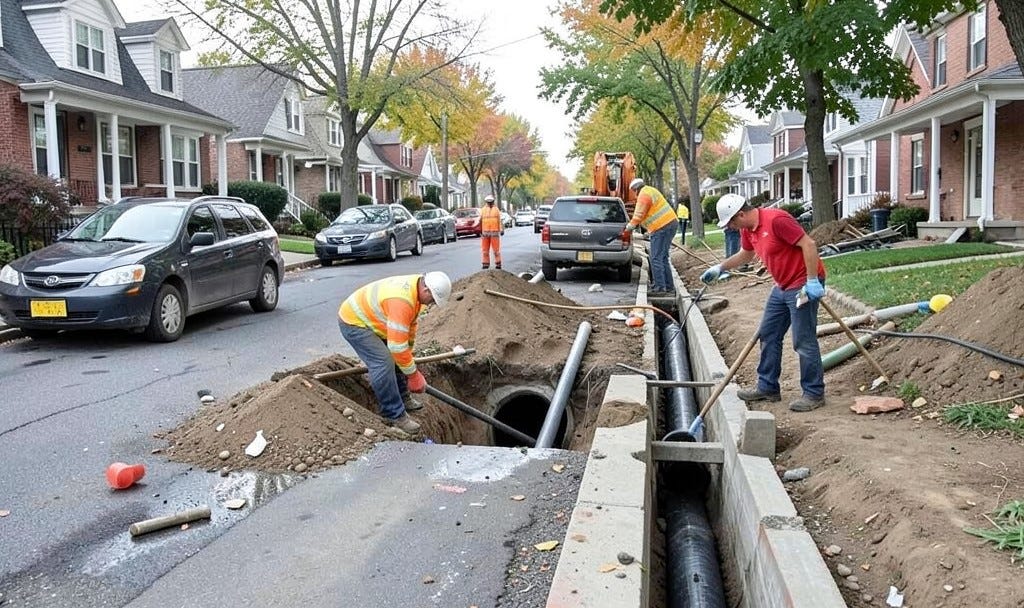
It's a Wednesday afternoon in Noe Valley, and I can't get to my own house. I'd just dropped my wife off downtown and was driving back home to work for the day, which is when I discovered that a five- to six-block chunk of my neighborhood had been sealed off entirely — no route in, no route out. I ended up parking well up on Clipper Street, near Grand View, and walking down the hill to my own front door.
I've lived in this neighborhood for thirty years. I have seen plenty of construction. I have never seen anything quite like this.
Six weeks and counting
For about six weeks now, parking has been suspended on both sides of my street and on nearby side streets for what I understand is sewer line replacement work. I don't object to that — the work is necessary, and I get it. But that Wednesday went well beyond ordinary construction inconvenience. An entire pocket of the neighborhood was cut off for a full day, with no warning I can point to.
Two projects, one coincidence?
So I did what I do: I went looking for answers myself. Turns out there isn't just one project going on near me — there's the SFPUC's Noe Valley Water Main Replacement Project (with final paving reportedly scheduled for the very week this happened) and separate Public Works sewer and pavement work on the 24th Street corridor. Two agencies, overlapping footprints, and — as far as I can tell from the outside — no visible sign of coordination.
The city actually has a body for exactly this problem: a monthly committee called CULCOP (the Committee for Utility Liaison on Construction and Other Projects), chaired by Public Works, whose entire purpose is to keep agencies from digging up the same neighborhood at the same time without a plan. I'd genuinely like to know whether it worked here, or whether this was two unrelated schedules colliding by accident.
The city's own notice standard: a sign
Here's the part that actually got under my skin. As best I can tell, the formal notice requirement for a closure like this is a printed sign, posted on site, 72 hours in advance. That's it. No mailer, no email, nothing tied to the property records the city already has for every homeowner on the block. For a closure that cuts off an entire neighborhood for a day, a posted sign I could easily have walked past isn't adequate notice — not in 2026.
Then the tickets started
Here's the twist. It's long been a tolerated, if technically illegal, practice on our block for people to park in their own driveways with part of the car overhanging the sidewalk — because there simply isn't enough on-street parking in this part of San Francisco. It hasn't been actively enforced here in years. And it started being enforced, apparently in response to complaints, in the exact same weeks the city's own construction eliminated the on-street parking that would otherwise have been there. I got three citations in one week, at $108 each. So did several of my neighbors.
The city has already acknowledged, through the Mayor's PermitSF initiative, that complaint-driven enforcement of driveway and sidewalk parking has led to inconsistent and unfair treatment, and it has granted relief to residents in comparable situations elsewhere. I'm asking that ours be reviewed in that same light.
The question that actually matters
Of everything I sent the city, this is the one I care about most:
How, specifically, and by when, will resident notification for work like this actually improve — not just an assurance that it will?
What I'm asking for
This week I sent a formal letter to the Director of San Francisco Public Works, with copies to the Mayor's Office, our District 8 Supervisor, the SFPUC, and SFMTA's parking enforcement division, asking for a written response on four things:
A concrete method and timeline for improving resident notification — not a vague promise;
Whether the overlapping projects near me were actually coordinated, or just collided by accident;
The remaining schedule for restoring normal parking on my block and the surrounding streets; and
A review of the citations issued on our block during this construction period.
I don't think the underlying infrastructure work is the problem — sewer and water lines need replacing, and I'd rather the city do it than not. What I want is for it to be done with the kind of coordination and communication that a city of this size, in this decade, should be capable of. I'll post an update here once I hear back.
If you've dealt with something similar in your own neighborhood, I'd like to hear about it in the comments.